Carnival (2024)
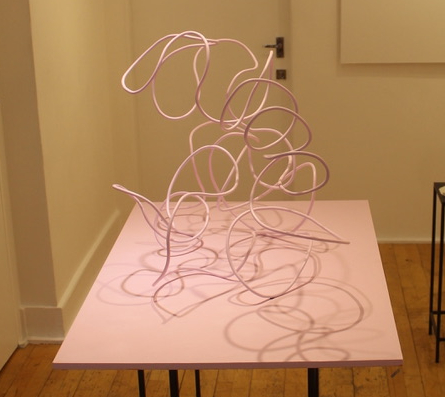
Mild steel, mdf, acrylic, aromatherapy oil
Playing with colour, movement, shadows and olfactory senses this springy representation of joy simply invites you to swoosh around your memories of fun fairs, twirling ribbons, eating candy floss, and dancing with friends.
In *Carnival*, Juliet conjures a whimsical yet enigmatic celebration of form and sensory association. This sinuous metal sculpture, painted in a delicate pastel pink, twists and loops in an exuberant dance of lines, its abstract contours capturing the chaos and joy of a festive moment frozen in time. The gentle curves evoke movement, as though the piece itself might spring to life, spinning in tandem with the unseen revelry it implies.
Accompanying the visual feast is the subtle, evocative scent of candyfloss, transforming the viewer’s experience into something multisensory and immersive. The aroma instantly transports one to a fairground, mingling nostalgia with the present and creating a synaesthetic dialogue between memory and form. The interplay of light and shadow across the sculpture further animates it, casting looping shapes that ripple across its surroundings, as if extending its carnival spirit into the space itself.
*Carnival* is at once playful and profound, an invitation to revel in the beauty of pure abstraction while tracing one’s own emotional associations. The piece seems to capture the fleeting essence of joy—the effervescent swirl of a moment, ephemeral yet enduring in its impression
Girls World I (2025)
Jesmonite
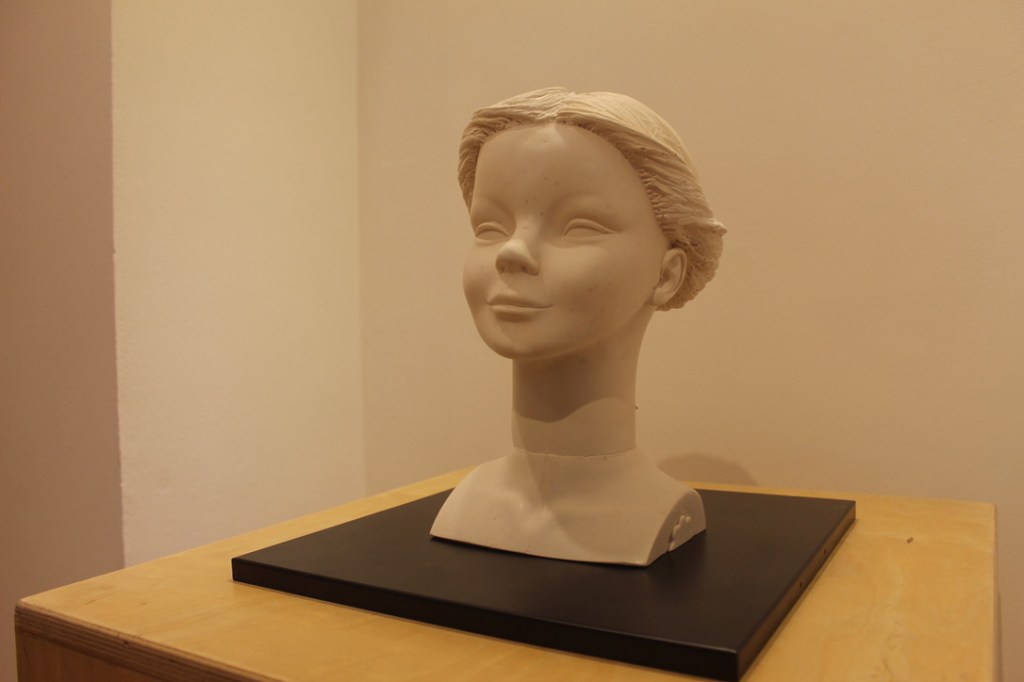
The Girls Word Styling Head in 1970s/80s was a ‘must-have’ toy. A plastic white females decapitated head to paint make up on, and style its straight nylon hair.
This evocative casting of the iconic *Girls World* head reimagines a beloved retro toy as a blank canvas for creative exploration. Stripped of its glossy commercial finish, the piece takes on a spectral quality, presenting a haunting reflection of childhood nostalgia re-contextualised in the realm of fine art.
The plaster medium emphasises texture and imperfection, lending the figure a raw, almost ancient appearance, as though unearthed from an archaeological site. The absence of vibrant colour allows the viewer to focus on the subtle contours and craftsmanship of the form.
This work not only recalls the personal rituals of styling and adornment that the original toy encouraged but also invites deeper questions about memory, material culture, and the enduring impact of consumer objects on our collective identity. In this transformed state, the *Girls World* becomes less a toy and more a monument—a meditative piece caught between the ephemeral and the timeless.
.
Every Cloud (2024)
Acrylic on canvas, sterling silver
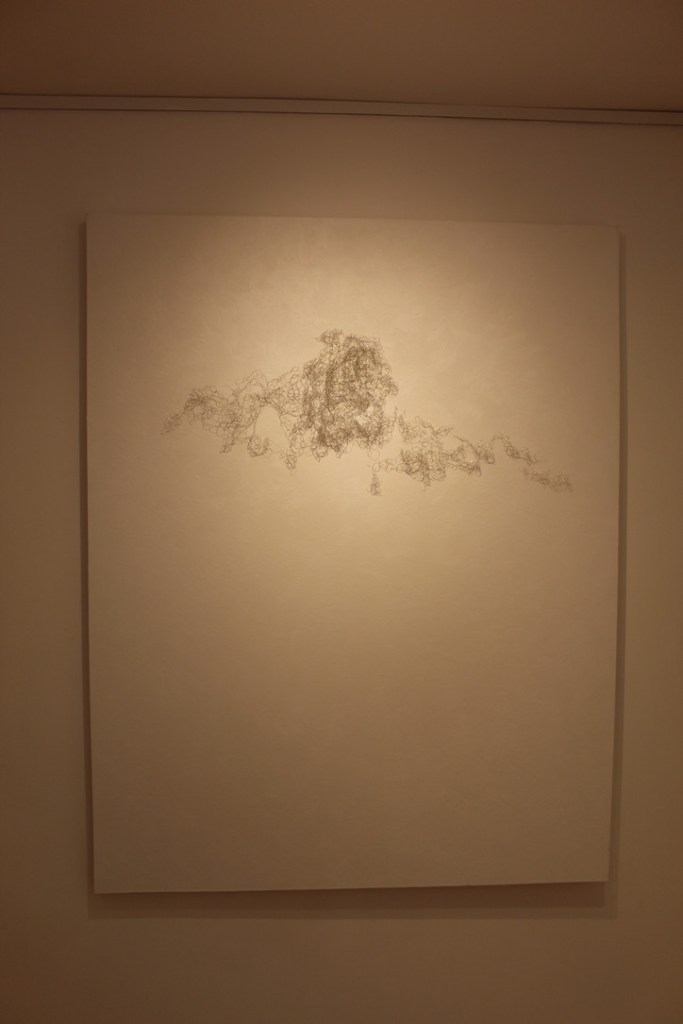
“Every Cloud” is a minimalist expression that deftly balances material delicacy and conceptual depth. Against a stark white textured canvas, a fragile, meandering thread of silver weaves an ephemeral, cloud-like form. The choice of silver—a material traditionally associated with permanence and value—imbues the transient, amorphous shape with a sense of quiet irony.
The cloud, an age-old metaphor for impermanence and change, is rendered here with an intricate, almost calligraphic precision. The piece seems to hover between abstraction and representation, inviting viewers to contemplate the fleeting nature of beauty, the weight of lightness, and the paradox of something so insubstantial being wrought from a precious, enduring medium.
The white backdrop enhances the ethereal quality, creating a void in which the silver thread floats, casting subtle shadows that shift with the light. This interplay adds a dynamic dimension to the work, making it as much about presence as absence. “Every Cloud” is a poetic meditation on fragility, transformation, and the silver linings found in life’s most fleeting moments.
Untitled (2022)
Found objects, sound recording, lentil soup, Comfort fabric conditioner
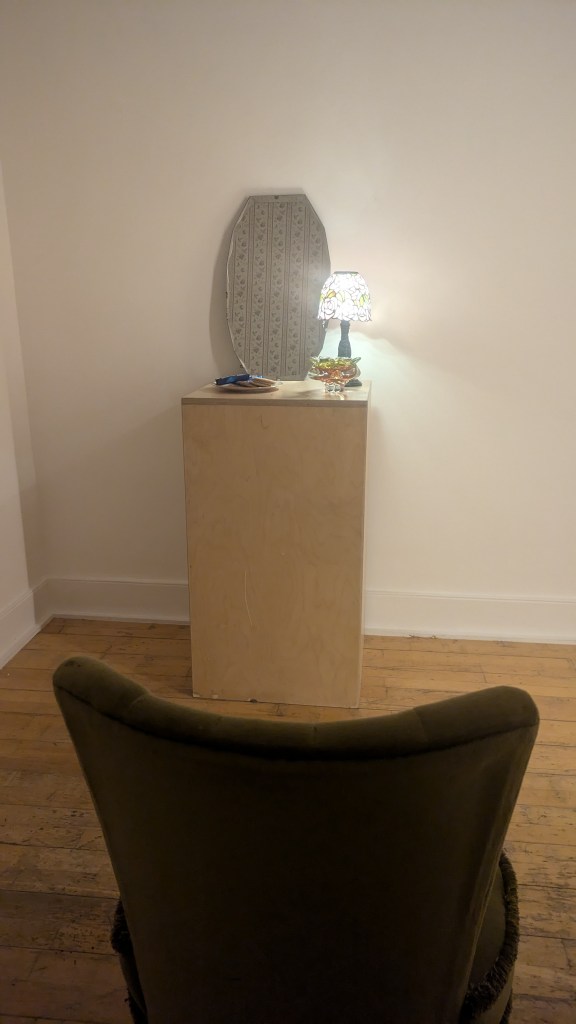
Shown at ‘Free for All’ Group exhibition at the Pipe Factory Glasgow 2023, Re:collection solo exhibition at 67 York Street Galleries London 2025 and the Pittenweem Arts Festival 2025 at their inaugural Emerging Artists Exhibition.
In a dimly lit room steeped in quiet nostalgia, an evocative art installation invites viewers to step into an intimate tableau. The space is sparse yet deliberate: a mid-century soft velvet vintage chair sits confidently in the centre, facing a small table upon which an ashtray lamp and a mirror rests. The tarnished mirror reflects a glimpse of dated patterned wallpaper—a subtle yet evocative detail that deepens the sense of place. The air is saturated with a trio of scents—homemade lentil soup, Comfort fabric conditioner, and the faint, acrid residue of extinguished cigarettes—conjuring an uncanny blend of domesticity and melancholia.
The installation blurs boundaries between the sensory and the conceptual. Visitors are encouraged to sit in the chair, immersing themselves in a soundscape of quiet domestic labour: the soft clinking of pots, the rhythmic stir of soup being made in an unseen room. The experience is hauntingly ordinary yet strangely poignant, a tender ode to the rituals of home and memory. The artist transforms the space into a theatre of the mundane, where smell, sound, and texture evoke a ghostly presence— a moment in time lived and remembered.
The objects on the table and the reflected wallpaper creates new layers of dialogue within the work. The wallpaper’s visibility in the mirror hints at a world beyond the immediate scene, extending the installation’s reach into the viewer’s imagination. The table, meanwhile, anchors the ashtray more firmly, intensifying the suggestion of a once-lived domestic moment.
This work doesn’t demand to be understood in traditional terms; instead, it asks to be felt, savoured, and smelled. It lingers in the mind long after leaving, much like the scent of lentils simmering or the faint, persistent smoke of a cigarette stubbed out hours ago. It is a meditation on the invisible threads of memory that tie us to spaces, objects, and the stories they hold.
Lavinia (2022)
Clay earth, repurposed building materials, moss and various donated plants

This work was made in collaboration with Icelandic artist Emil Gunnarsson and the Glasgow based environmental charity Grow 73. It was designed and created in response to an intergenerational project by Grow 73 involving local schools, care homes and the professional storyteller Amanda Edmiston (Botanica Fabula).
This 35 foot long figurative piece portrays the fictional character of Lavinia sleeping in a quiet meditative area of the Grow 73 Community Garden in Overtoun Park, Rutherglen. All materials used were from the site including the clay dug up while the gardens irrigation system was being laid.
A highly successful community participation project, the ‘birth’ of Lavinia involved around 20 local volunteers taking part and it was unveiled at an event attended by almost 1000 people.
Many Hands (WIP)

Jesmonite, “Remade”, Wood, Seeds
(Shown here on loan at 67 York Street Gallery, London, 2025 prior to permanent install)
This striking series of sculptures captures moments of raw simplicity and tactile interaction, commemorating the human touch behind the creation of a grassroots community garden. Each piece immortalises the hands of volunteers and board members, preserving their gestures as enduring symbols of collaboration, care, and connection.
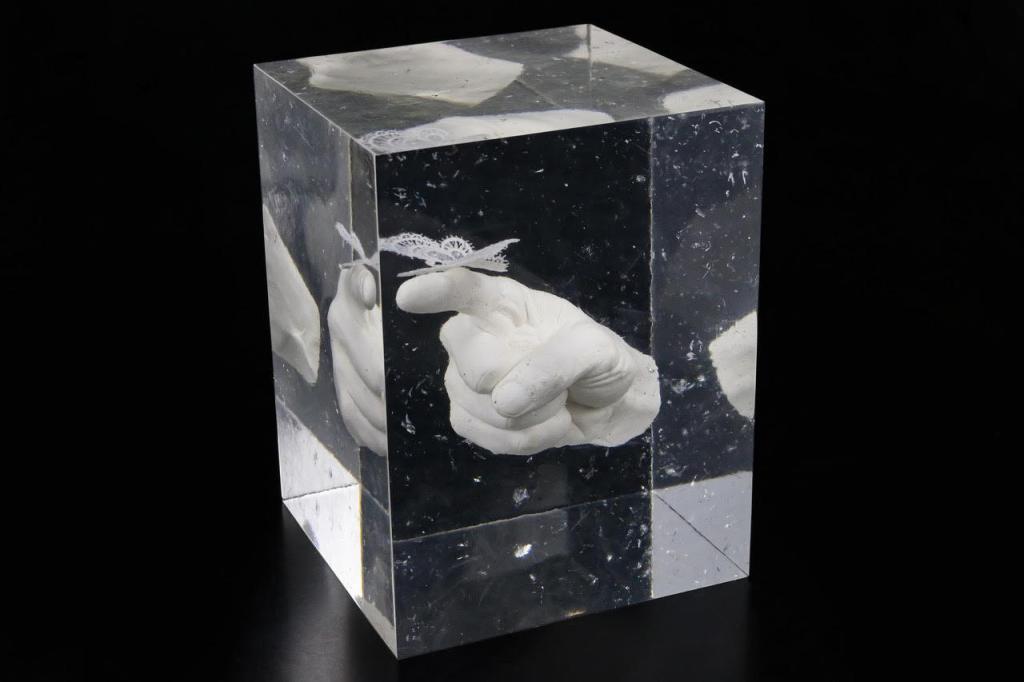
The first sculpture features a hand firmly clutching a piece of rough-hewn timber, a powerful representation of the craftsmanship and physical labour that built the garden’s structure. In the second, two hands engage in a poignant act of exchange—one hand gently passing seeds to another. This intimate gesture embodies the garden’s ethos of nurturing growth, both in the soil and within the community. The final piece captures a hand with a butterfly resting delicately on its finger, a moment of serene harmony that celebrates the life and beauty the garden fosters.
The sculptures are encased in *Remade*, an innovative material developed by Midton Acrylics, composed of 80% recycled acrylic. This choice not only aligns with the sustainable ethos of the community garden but also speaks to the broader theme of renewal, transformation, and resourcefulness. The material’s clarity and light-refracting properties elevate the ethereal quality of the pieces while reflecting the commitment to environmental responsibility.
Together, these works invite reflection on themes of labour, generosity, and the interconnectedness of people and nature. The use of *Remade* reinforces the sculptures’ celebration of renewal and the enduring impact of collective action, transforming ordinary gestures into profound meditations on sustainability, community, and shared hope.
Rewind (2025)
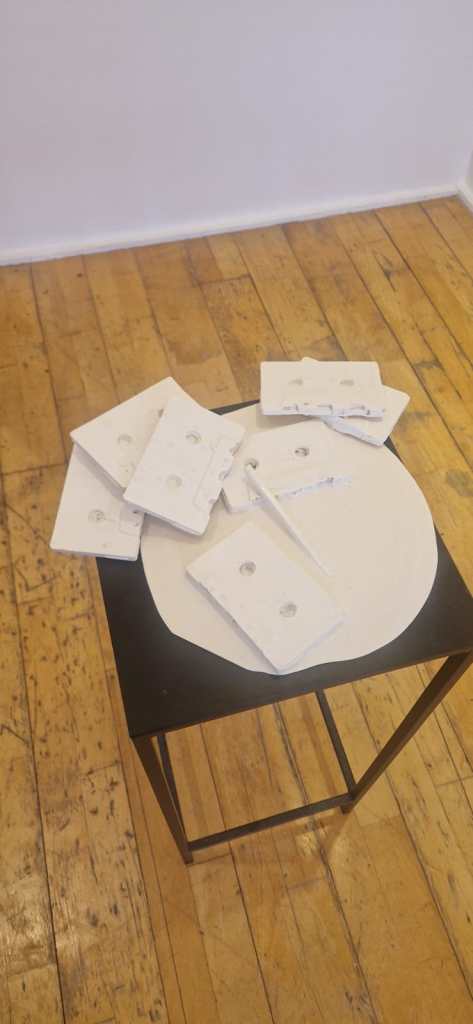
Jesmonite
In *Rewind*, the artist crafts a deceptively simple yet profoundly evocative meditation on memory, creativity, and obsolescence. At its core lies white, cast cassette tapes—weathered stripped of their function and cast aside—paired with a slender white pencil, poised as if ready to interact with the objects. This pairing recalls a tactile ritual familiar to a bygone era: the manual rewinding of tape with the barrel of a pencil, a small act of resourcefulness now rendered obsolete by advancing technology.
The monochromatic palette enhances the ghostly quality of the piece, imbuing it with a sense of absence and longing. The cassettes once repositories of sound and emotion, now sit as a relics, silenced by time. The pencil, an enduring symbol of creativity and agency, suggests an attempt to reconnect with the past—to rewind, repair, and reclaim moments that slip through the cracks of memory.
By elevating these mundane objects into the realm of sculpture, the artist invites the viewer to reflect on the intersection of the mechanical and the personal, the fleeting and the permanent. *Rewind* is both an ode to the analogue and a quiet interrogation of how we preserve and interact with the traces of what was once vibrant and alive.
Say What You See (2024)
Print on Canvas
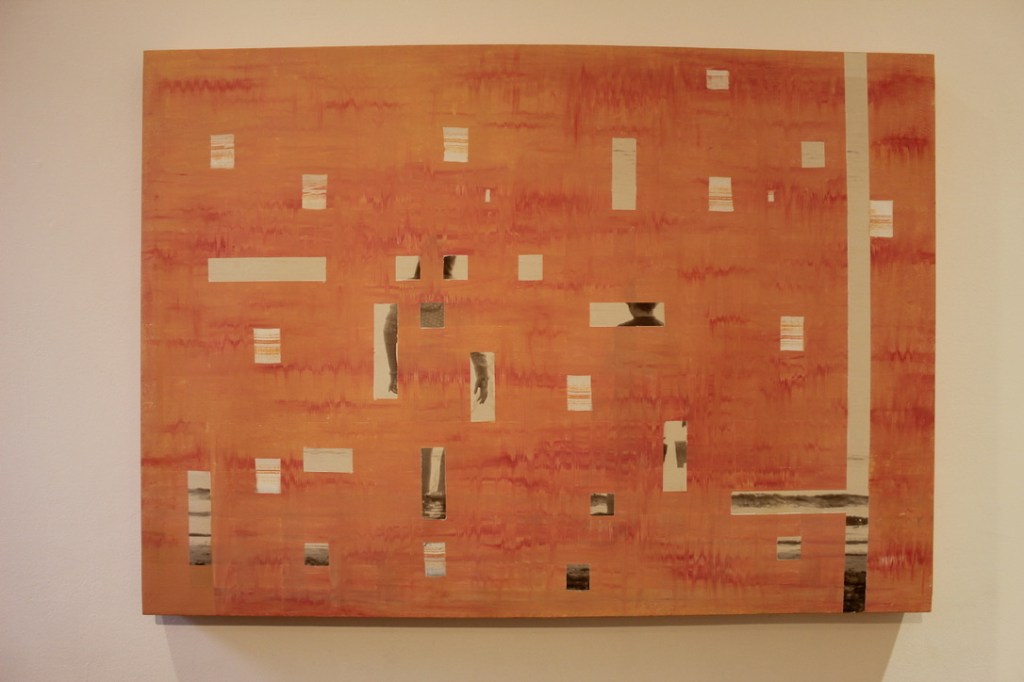
In *Say What You See*, the artist presents a deeply layered meditation on memory, perception, and identity. At first glance, the canvas appears dominated by a warm, textured grid of earthy rust tones, interrupted by stark white geometric forms. These abstract elements evoke both architectural rigidity and the fragmentary nature of thought. However, the true emotional weight of the piece reveals itself in the spectral figures—two silhouetted forms, two children, who seem to emerge like ghosts from the background.
The interplay of abstraction and figuration creates a palpable tension. The figures, rendered in muted tones, appear as if glimpsed through a haze of memory, their details obscured yet undeniably human. The contrast between their softness and the angular rigidity of the grid implies a struggle between structure and the fleeting, often fragmented nature of human experience.
The title, *Say What You See*, functions as both an invitation and a challenge. It asks the viewer to confront the subjective nature of interpretation—what is seen may be shaped as much by the viewer’s own past as by the artist’s intention. This piece defies any singular narrative, instead offering a space where memory, emotion, and perception overlap in a quietly powerful dialogue.

